Answerable for every barrier. Now every barrier has an owner.
You answer for accessibility across the organization and manage none of the teams who ship. limena routes each barrier to its owner, priced, and shows you who has cleared what.
Routed to Frontend in Jira. Re-test booked for release 4.14.
From chasing people to running a program.
The role is usually one person responsible for an obligation that only other people can discharge.
Findings go to owners, not to you
Each barrier lands with the designer, editor or engineer who can fix it, as a ticket in Jira, Linear or GitHub.
Your calls, logged as evidence
The judgments only you can make are recorded against the criterion, with your name and the date.
Something to show, without a deck
A priced view of what’s open and what’s protected, ready for your next leadership update.
How the program runs
From findings to a program you can report on.
The same four steps every release, and you are in only the ones that need you.
- Step 01
Route
Each barrier goes to the role that owns it under W3C’s ARRM, as a ticket in Jira, Linear or GitHub. You set who owns which task once, in Settings.
- Step 02
Rule
Criteria that need a person stay open until someone rules on them. The verdict and its note are recorded against the criterion, with a name and a date.
- Step 03
Re-test
Fixes are re-tested at release. Status, reopens and re-test results come back from the tracker, so you stop chasing.
- Step 04
Report
The executive summary opens on what is at risk, what moved, and whether you will hit the date your team set.
What you take to leadership
One page that answers “are we getting better?”
The executive summary is the console’s own view, not a deck you rebuild each quarter. Leadership can have it by email once a month.
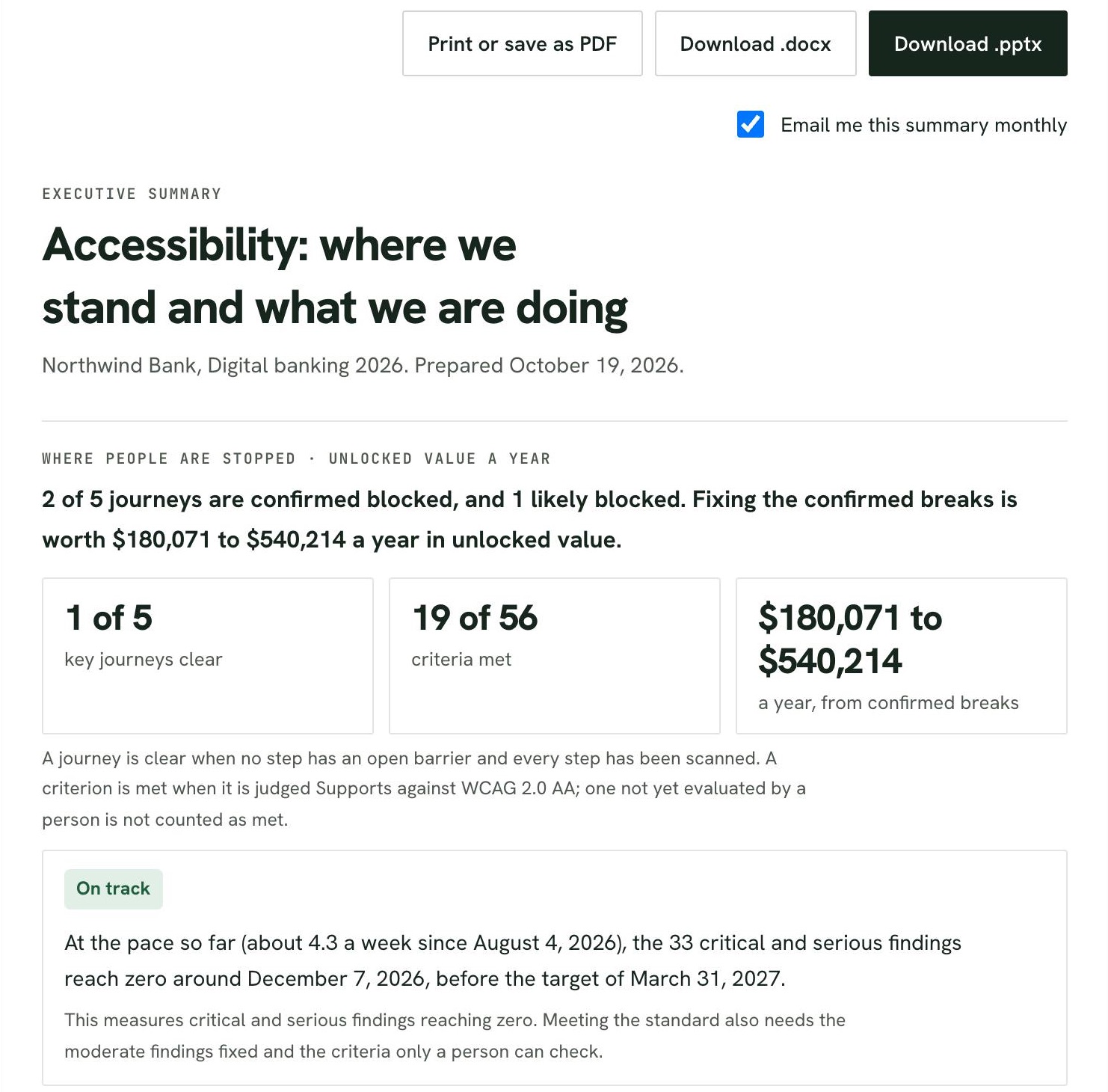
Cost first
The figure at risk across your journeys, from the same calculation every screen in limena uses.
On track or behind
Against a target date your team sets, so the question is answered before it’s asked.
Ready to send as it is
Print it, download it as Word or PowerPoint, or have it emailed each month. Below the fold: what to fix first and the decisions leadership needs to make.
What limena ranks first
What crosses your desk, and what doesn’t.
limena routes the routine work and keeps the judgment calls for you.
- ID upload not keyboard reachableRouted to FrontendBlocker: $72,000/yr
- Custom date picker: is it operable?Needs your judgmentYour call
- Fees chart missing alt textRouted to ContentLow
- Jira
- Linear
- GitHub
Common questions
Do I still triage every finding myself?
No. Ownership rules send each barrier to the role that fixes it. What reaches you is the judgment work, anything nobody owns yet, and the summary of who has cleared what.
What about the criteria automation can’t test?
They stay open until a person rules on them. You can record a verdict in the console, or from the browser extension while you inspect the page. If you want a second pair of hands, you can invite an expert into the program.
Do the teams who fix things need a paid seat?
Seats are unlimited on Team, Growth and Enterprise, so the designers, editors and engineers you route work to can join without a seat count. Monitor is one seat.
Will it fit how our teams already track work?
Tickets go to Jira, Linear or GitHub Issues. Status, reopens and re-test results come back, so the record in limena matches the tracker without anyone copying it across.
How do I show progress without building a deck?
Share the executive summary, or have it emailed to leadership each month. It leads with cost, shows the trend, and says whether you are on track for your date.
Bring the product you worry about most.
We’ll run limena on one of your journeys and show you each barrier priced, who owns the fix, and what to do first.